When I was working on growing the international Stack Overflow communities, my constant problem was that the number of initiatives I wanted to run far exceeded the time and resources I had to organize them. As I thought about which initiatives to run and which to put off, I kept coming back to the Pareto principle and asking myself: “Which 20% of initiatives will drive 80% of engagement?”
Today I’d like to try answering that question through the lens of engagement cohorts, specifically:
Which user cohort should one run initiatives for to have the biggest impact on their community?
Note: Whenever possible, you should work with all engagement cohorts, at least minimally.
To get to the answer, we’ll look at three other questions:
- Are there differences in engagement cohorts between times when a community is growing vs. declining?
- Does the proportion of engagement cohorts change as a community grows?
- How do users move between engagement cohorts?
As always, a big thank-you to Pavel Klykov for the technical part of the research.
So, let’s dive in. But first:
TL;DR
If you’re short on time and resources, focus on users in the Regular cohort.
Now let’s look at the cohorts from three angles.
Are there differences in engagement cohorts between times when a community is growing vs. declining?
Yes, the difference shows up in the Regular and Active cohorts.
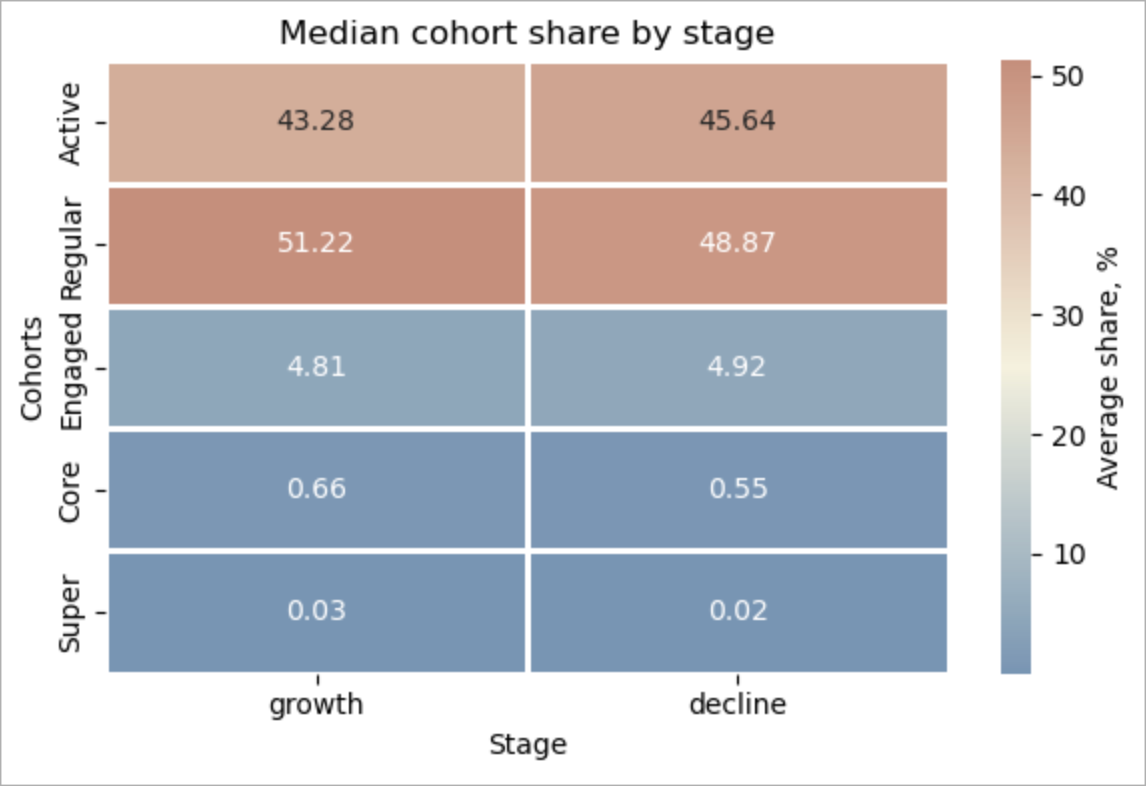
From what I can see, communities grow and fade monotonically. User activity gradually rises or falls across all engagement levels at once. Growth is driven by a larger share of users moving from the Active cohort into the Regular cohort and other, more engaged cohorts.
Does the proportion of engagement cohorts change as a community grows?
Yes, it does change while the community is growing, but past a certain point, the cohort proportion levels off.
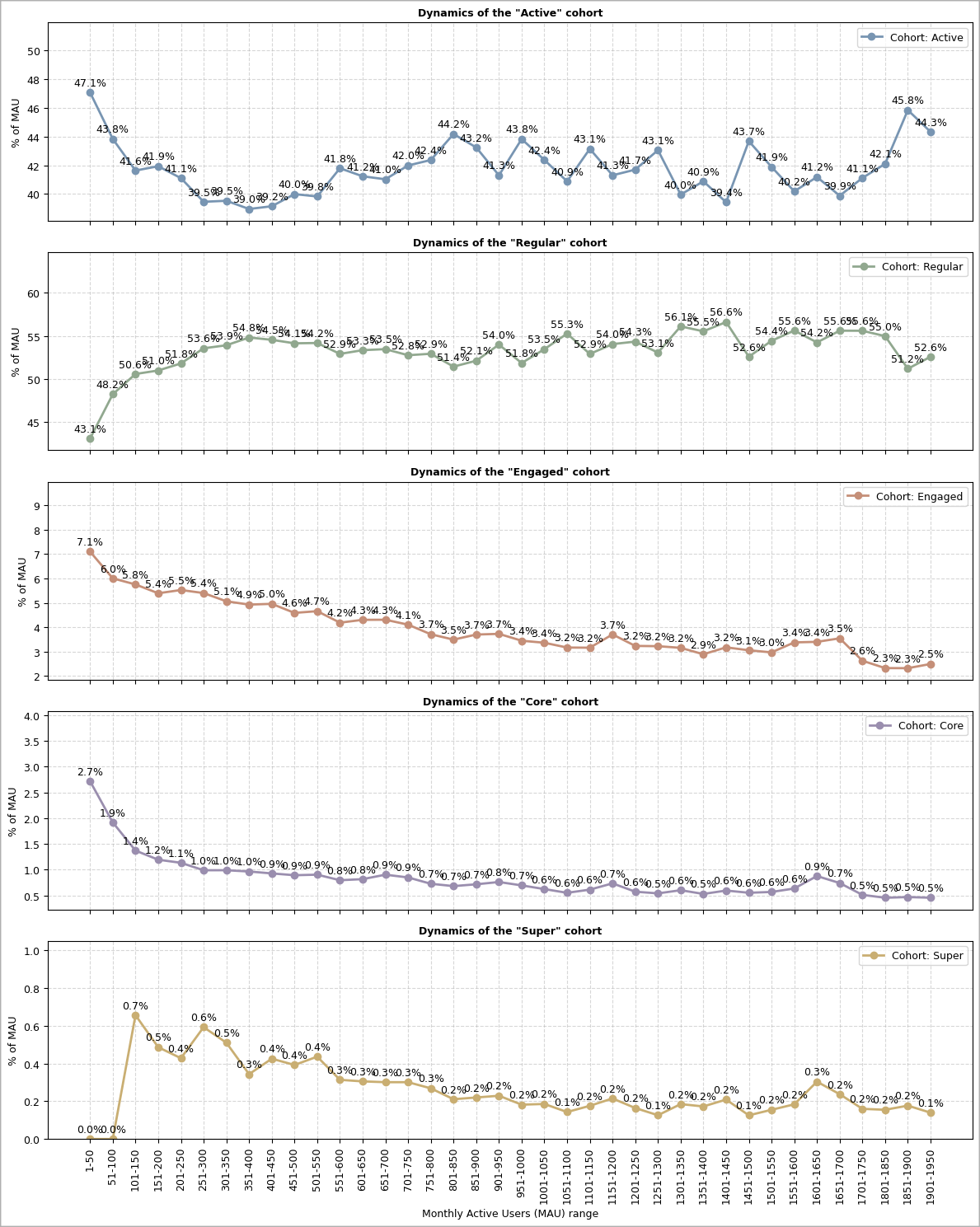
The chart above shows the percentage of users at each engagement cohort as a function of community size (X-axis is MAU). As the community grows, the share of Regular users rises while the share of Active users falls.
From this, we can hypothesize that in a community’s early stages, growth is tied to effective new user retention (users moving from Active to Regular). But past a certain size (~400 MAU), the structure stops changing, and further growth is driven by other factors.
One more takeaway: in a large community, it’s harder to become a super user. I think that the reason for this is that there are so many active users that high activity of a certain user starts to look ordinary by comparison to others.
How do users move between engagement cohorts?
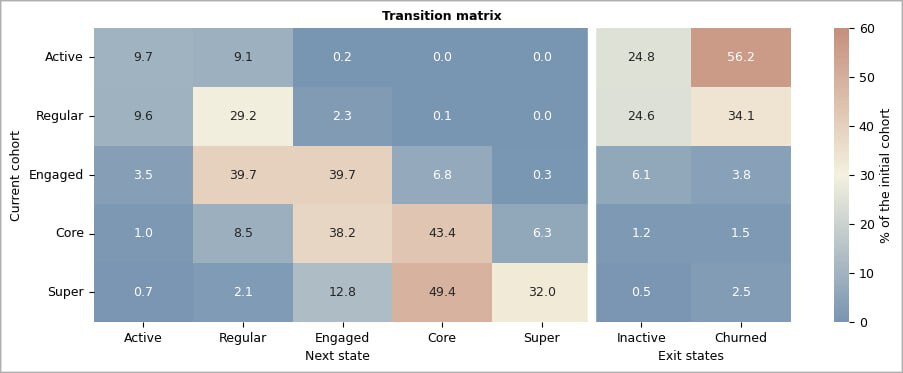
Regular, engaged, and core users mostly stay in the same cohort, while super users tend to drop down to core. The biggest churn (and deactivation) shows up in the Active and Regular cohorts.
What does all this mean in practice?
If you want to grow your community but don’t know where to start, start by working with the Regular cohort. Regular users collectively post more messages than any other cohort, and the cohort itself is large. At the same time, churn and deactivation among these users is very high, which means there are a lot of opportunities here.
Moreover, users from all cohorts, except Active, mostly re-activate in the community through the Regular cohort. As well as, early-stage community growth is tied to effective conversion of Active users into Regular users.
In other words, if you want the biggest impact from your community initiatives, focus your efforts on retaining and engaging the Regular users. Based on our estimates, the Regular user cohort includes users who create between 2 and 9 posts per month.
If you’d like us to help you find the most efficient ways to grow your community, email me or try Practical CM app.